
Affiliate Marketing Plan: Earn Your First Commissions

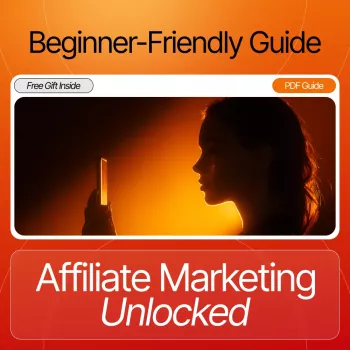
Affiliate Marketing Unlocked: a simple plan for your first commissions
Affiliate marketing sounds easy on the surface—share a link, earn a commission—but most beginners stall in the same places: picking a niche that actually holds up, finding programs with clear rules, creating content that feels helpful (not salesy), and figuring out what’s working once links are live. Our team created Affiliate Marketing Unlocked: The Beginner-Friendly Guide (Digital eBook) to turn “Where do I start?” into a straightforward, repeatable routine you can fit around real life.
What affiliate marketing is (and what it isn’t)
Affiliate marketing is a performance-based model: a business pays you a commission when your tracked referral leads to an action—most often a sale, sometimes a lead or sign-up. The core players are the merchant (brand), you (the affiliate/publisher), the customer, and the tracking layer (an affiliate network or a direct program).
It’s also not a “post once, get paid forever” shortcut. Sustainable results come from useful content, consistent publishing, and small improvements over time—like better headlines, clearer calls-to-action, and tighter offer-to-audience match. The beginner-friendly upside is the low startup cost compared to inventory businesses, plus the flexibility to publish on platforms that fit your strengths (written, video, email, or social).
Affiliate Marketing Basics at a Glance
| Term | Meaning | Why it matters for beginners |
|---|---|---|
| Affiliate link | A tracked URL assigned to an affiliate | Ensures sales/leads are credited correctly |
| Commission | The payout per action (sale/lead) | Determines earning potential and content priorities |
| Cookie window | How long tracking lasts after a click | Longer windows can improve conversions over time |
| Conversion rate | Percent of visitors who complete the action | Helps you decide what to improve (offer, page, audience match) |
| Disclosure | Clear notice that links may earn a commission | Builds trust and supports legal/platform expectations |
What’s inside the eBook: a step-by-step beginner path
Our goal with Affiliate Marketing Unlocked is to make the process feel concrete instead of vague. You’ll get a plain-language breakdown of tracking and payouts, plus a start-to-finish roadmap: choose a direction, select offers, create content with intent, publish, and refine using simple metrics.
We also keep the focus on repeatable systems—what to do weekly—rather than overwhelming stacks of tools. That structure helps you avoid common early traps like niche hopping, promoting mismatched products, or publishing without a conversion plan.
A practical launch plan that fits into a busy week
If you want momentum without burnout, the fastest path is usually the simplest one: one niche angle, one primary platform, and a small set of offers that truly fit your audience’s problem. Here’s a realistic weekly cadence we recommend when you’re starting out:
- Day 1–2: Choose a niche angle tied to real problems people already search for (not just what’s trendy).
- Day 3: Pick one primary platform (blog, short video, long video, or email-first) so you’re not context switching all week.
- Day 4–5: Create two types of content: (1) problem-to-solution education and (2) decision content (comparisons, best-of lists, “X vs. Y”).
- Weekend: Publish, add disclosures, and set up simple tracking so improvements are based on results, not guesses.
Weekly Routine Template (Beginner Pace)
| Block | Time | Outcome |
|---|---|---|
| Research | 30–60 min | 1 content idea tied to a clear audience problem |
| Create | 60–120 min | Draft/script + affiliate placements planned (not forced) |
| Publish | 30–60 min | Live post/video + disclosure + basic formatting |
| Improve | 20–40 min | Update headline, link placement, or call-to-action based on clicks |
Who this guide is for (and who should skip it)
How to use the eBook for faster progress (without burning out)
Simple 30-Day Checklist
| Week | Focus | Minimum target |
|---|---|---|
| 1 | Foundation | Pick niche angle + join 1–2 affiliate programs |
| 2 | Publish | 2 pieces of content with clear calls-to-action |
| 3 | Build trust | 1 deeper guide + 1 quick tip piece that links back |
| 4 | Optimize | Review clicks + improve link placement + add 1 new offer |
Pair it with the right digital tools from our shop (optional add-ons)
- Home Layout Checklist (Digital Download) for a simple comfort-focused reset that supports your work routine.
- Turning Any Space into a Relaxing Retreat (Digital Guide) if you’re trying to build a steady creative rhythm without feeling overstimulated.
Product details and what you receive
Affiliate Marketing Unlocked: The Beginner-Friendly Guide is a digital eBook designed for quick reference while you plan and publish. Delivery is instant online after checkout, and it works best alongside a simple note-taking system so your learning turns into weekly actions.
For additional guidance beyond our guide, you can review disclosure expectations from the FTC, typical affiliate program rules (example: Amazon Associates Operating Agreement), and Google’s recommendations for creating helpful product-related content (Google helpful content guidance).
FAQ
What is affiliate marketing and how does it work step by step?
Affiliate marketing is when you promote a tracked link and earn a commission when someone completes an action like a purchase or sign-up. The basic steps are: choose a niche, join an affiliate program, create helpful content, add clear disclosures, publish and drive traffic, then track clicks and conversions to improve what you post next.
Do you need a website to start affiliate marketing?
No, but a website can give you more long-term control and a central place for your content. Many beginners start on a single platform like short-form video, YouTube, or email, as long as the affiliate program allows it.
How long does it take to make the first affiliate commission?
It depends on your traffic, how well the offer fits your audience, and how consistently you publish. If you already have an audience it can happen quickly, but starting from zero often takes weeks or months, which is why a consistent 30-day baseline is a practical first benchmark.



Leave a comment